


Golf Tips for Back Health • Back to Prime Physiotherapy & Performance
If you’ve ever finished a round of golf with a sore lower back, the culprit may not be your swing—it may be what happens every time you pick up your golf ball.
Think about it.
During a typical round, you’ll bend down dozens of times to place a tee, retrieve your ball, repair a divot, mark your putt, or pick up your club. These repetitive movements place significant stress on your spine when performed incorrectly.
Fortunately, one simple movement can dramatically reduce that stress.
The Golfer’s Lift
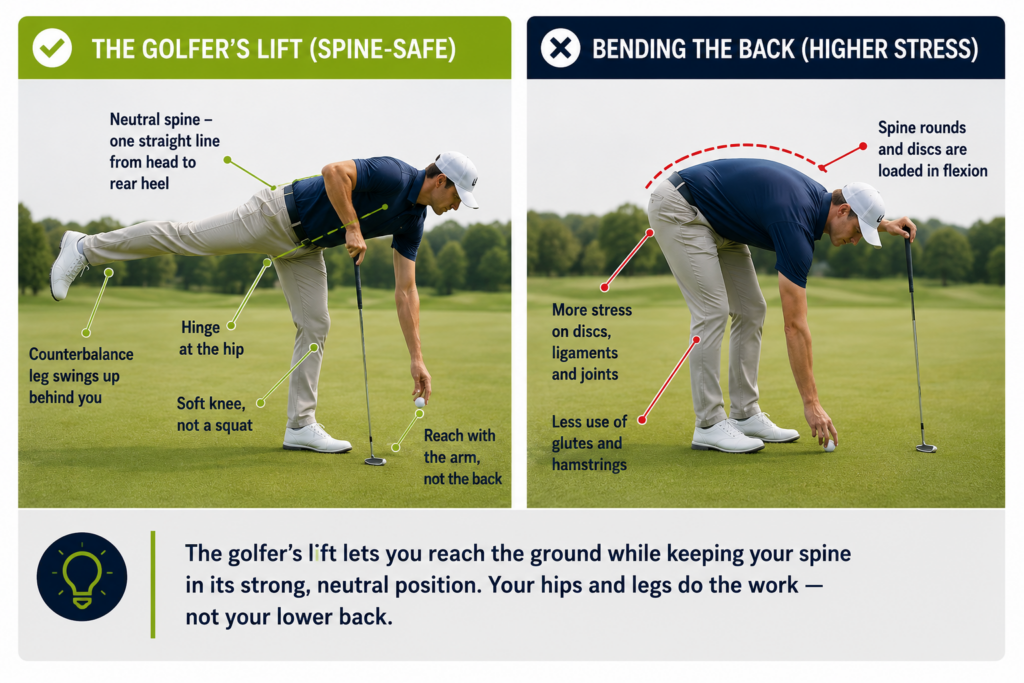
The Golfer’s Lift is a spine-safe technique that allows you to reach the ground while maintaining a neutral spine.
Instead of bending through your lower back, you hinge at your hips while allowing one leg to extend behind you for balance. This keeps your spine aligned and lets your hips and legs perform the work rather than placing excessive load on your lumbar discs.
Key points of the Golfer’s Lift:
- Maintain a neutral spine from your head to your extended leg.
- Hinge through your hips—not your lower back.
- Keep a slight bend in your standing knee.
- Extend your opposite leg behind you to act as a counterbalance.
- Reach toward the ball without rounding your back.
This movement distributes forces through your hips, glutes, and hamstrings rather than your spinal discs.
Why Bending Matters More Than You Think
Many golfers instinctively bend by rounding their backs.
While this may feel easier, it significantly increases stress on the structures of the lower spine.
Research from Dr. Stuart McGill’s Spine Biomechanics Laboratory has shown that spinal discs are most vulnerable when repeatedly loaded in a flexed (rounded) position.
Every time you bend with a rounded back:
- Your spinal discs experience higher compressive forces.
- Ligaments and joints are placed under greater stress.
- The muscles that stabilize your spine become less effective.
- The risk of developing back pain or aggravating existing injuries increases.
Over hundreds—or even thousands—of repetitions, these small movements can contribute to persistent low back pain.
Spine-Safe vs. Spine-Stressed
✅ The Golfer’s Lift
- Neutral spine
- Hip hinge movement
- Leg extends behind for balance
- Uses glutes and hips
- Lower stress on discs and joints
- Better long-term back health
❌ Rounded Back Bend
- Spine flexes forward
- Increased disc loading
- Less contribution from hips and glutes
- Greater strain on ligaments
- Higher risk of irritation and injury
Small Changes Make a Big Difference
Golf is full of repetitive movements.
Improving just one of those movements can reduce unnecessary stress on your back throughout every round.
Whether you’re retrieving your ball after sinking a putt or picking up your tee, practicing the Golfer’s Lift helps build better movement habits that protect your spine over time.
Back Pain Doesn’t Have to Be Part of Golf
At Back to Prime Physiotherapy & Performance, we help golfers identify the specific movement patterns contributing to back pain using the McGill Method and evidence-based physiotherapy.
Our goal isn’t simply to reduce pain—it’s to help you move more efficiently so you can continue playing the game you love.
Whether you’re dealing with recurring back pain or looking to prevent injury before the season begins, we’re here to help.